
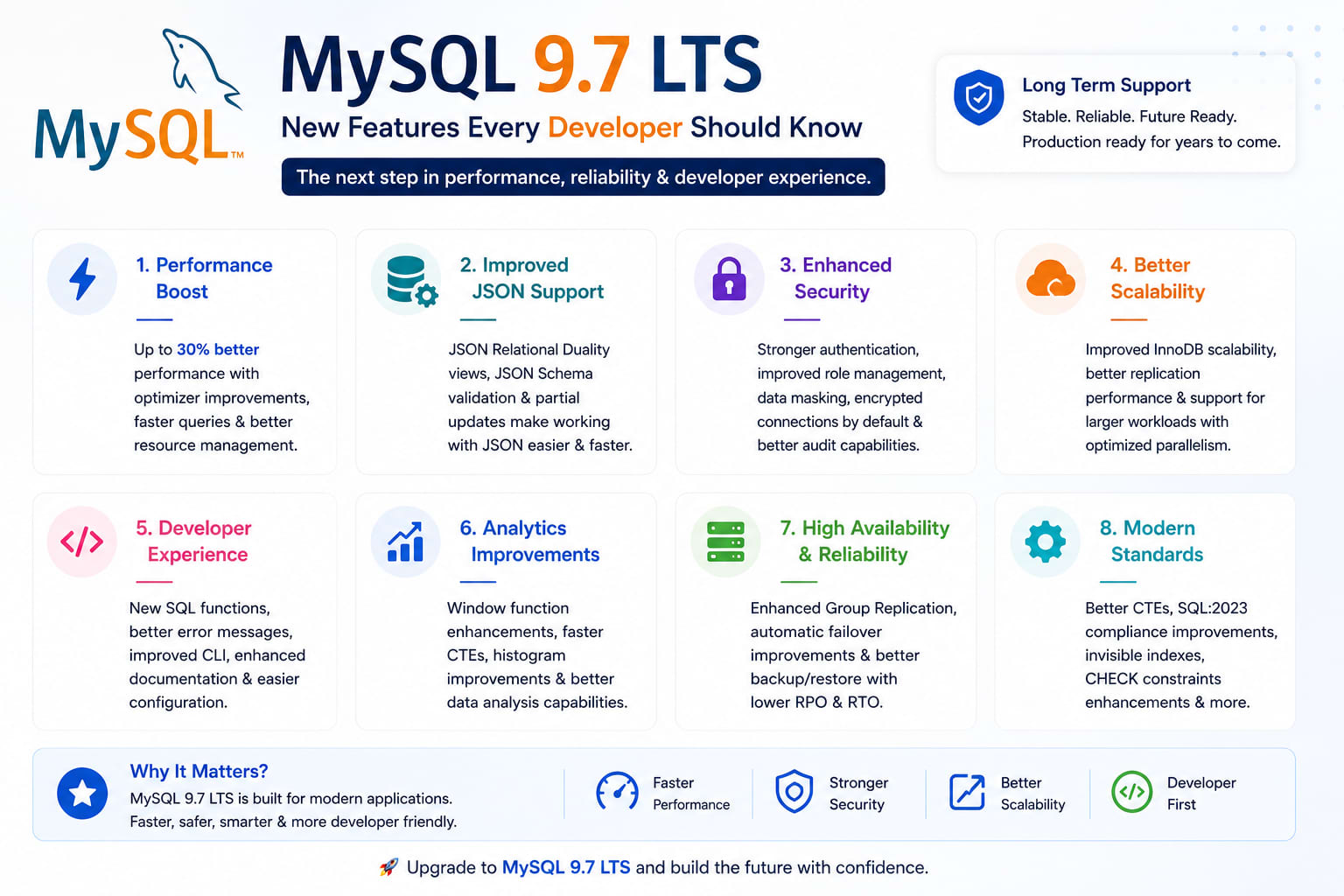
MySQL 9.7 LTS: New Features Every Developer Should Know
Oracle shipped MySQL 9.7.0 LTS in April 2026, and it's a bigger deal than a typical point release. It's the first release in a new Long-Term Support line, and — more importantly for most of us running the free Community Edition — several features that used to be Enterprise-only just became free.
Why This Release Matters
MySQL runs on a two-track model: Innovation releases ship frequent smaller updates, and every so often those innovations get consolidated into an LTS release meant for teams who want a stable branch to standardize on for years. 9.7 is that consolidation point, and it comes with roughly eight years of combined premier and extended support — a real target if you're planning an upgrade or a fresh deployment rather than chasing every innovation release.
The headline story isn't just "new LTS branch," though. It's that a chunk of what used to require an Enterprise license is now sitting in Community Edition.
1. Hypergraph Optimizer, Now in Community Edition
The Hypergraph Optimizer — MySQL's modern query planner built to handle complex joins better than the traditional optimizer — is no longer locked behind Enterprise. It's a switchable optimization, so you can turn it on for a session or for a single query without touching your whole instance:
sql
-- Enable for the whole session
SET optimizer_switch='hypergraph_optimizer=on';

-- Or enable it for just one query
SELECT /*+ SET_VAR(optimizer_switch='hypergraph_optimizer=on') */ *
FROM orders o
JOIN customers c ON o.customer_id = c.id
JOIN products p ON o.product_id = p.id
WHERE o.order_date > '2026-04-21';
If you've got queries with several joins that the classic optimizer struggles to plan well, this is worth testing against your slow query log before you assume you need a schema redesign.
2. JSON Duality Views Get Full DML Support
JSON Duality Views let you expose relational tables as JSON documents — useful if part of your app wants document-style access without maintaining a separate NoSQL layer. In 9.7, Community Edition gains DML support for these views, meaning you're no longer limited to read-only access; you can insert, update, and delete through the JSON view and have it reflect correctly in the underlying relational tables.
For teams running a Laravel app with a document-shaped API on top of a relational schema, this closes a gap that previously pushed people toward a separate MongoDB instance just for that one feature.
3. OpenTelemetry Support Built In
Observability tooling has been bolted onto MySQL with plugins and workarounds for years. 9.7 brings native OpenTelemetry support into Community Edition, so query and connection telemetry can flow directly into whatever observability stack you're already running — Grafana, Datadog, or anything else that speaks OTel — without a custom exporter.
4. Replication and Group Replication Observability
A set of previously Enterprise-only monitoring capabilities moved to Community Edition:
- Replication Applier Metrics — visibility into how fast a replica is applying incoming changes
- Group Replication Flow Control Statistics — insight into when and why flow control is throttling writes
- Group Replication Resource Manager — better control over resource allocation across replication group members
- Group Replication Primary Election — clearer visibility and control during primary failover
If you've ever had a replica silently fall behind and only found out when reads started returning stale data, these metrics are the difference between debugging blind and actually seeing what's happening.
5. Dynamic Data Masking (Enterprise Edition)
For teams on Enterprise, Dynamic Data Masking is now generally available. It masks sensitive column data — PII, payment details, and similar — at query time based on the querying user's privileges, without changing application code or duplicating data into a separate masked copy. Useful if you need to give support staff or analytics teams query access without exposing raw customer data.
6. Audit Log Enhancements (Enterprise Edition)
The Audit Log component picked up enhancements aimed at compliance-heavy environments — more granular event filtering and clearer logs for security review, which matters if you're subject to SOC 2, ISO 27001, or similar audit requirements.
Should You Upgrade?
If you're already comfortable running MySQL Innovation releases and want the query optimizer and observability improvements now, there's no reason to wait. If you're on 8.0 and have been holding off migrations, 9.7 LTS is a more sensible target than jumping onto an Innovation release you'd have to re-migrate off within months — you get a stable branch with roughly eight years of support ahead of it.
Before upgrading anything production-facing: check your current extension and plugin compatibility, review the official 9.7 release notes for any removed features (LTS releases are the only point where features get removed), and test the Hypergraph Optimizer against your actual join-heavy queries in staging before flipping it on everywhere.
Wrapping Up
The pattern worth noticing here isn't any single feature — it's that MySQL Community Edition keeps absorbing capabilities that used to be paywalled behind Enterprise. For teams running MySQL on a budget, that's the real headline of 9.7 LTS: better observability, a smarter optimizer, and more flexible JSON tooling, all without upgrading your license.